RESEARCH SALE · 35% OFF SITEWIDE · CODE RESEARCH35RESEARCH SALE · 35% OFF SITEWIDE · CODE RESEARCH35RESEARCH SALE · 35% OFF SITEWIDE · CODE RESEARCH35RESEARCH SALE · 35% OFF SITEWIDE · CODE RESEARCH35RESEARCH SALE · 35% OFF SITEWIDE · CODE RESEARCH35RESEARCH SALE · 35% OFF SITEWIDE · CODE RESEARCH35
Work out the concentration of a reconstituted lyophilized peptide and the volume of solution that contains a given amount. Concentration in mg/mL is numerically the same as µg/µL, which makes small aliquots easy to plan.
Concentration
5 mg/mL
= 5 µg/µL · 5,000 µg/mL
Volume for the target amount
50 µL
= 0.05 mL of solution
Aliquots per vial
40
How the calculation works
Concentration is the mass of peptide divided by the volume of diluent: C (mg/mL) = mass (mg) ÷ volume (mL). Because 1 mg/mL equals 1 µg/µL, the volume that contains a target amount is simply the target in micrograms divided by the concentration: V (µL) = target (µg) ÷ C (mg/mL). The number of whole aliquots is the total mass in micrograms divided by the target, rounded down.
Worked example
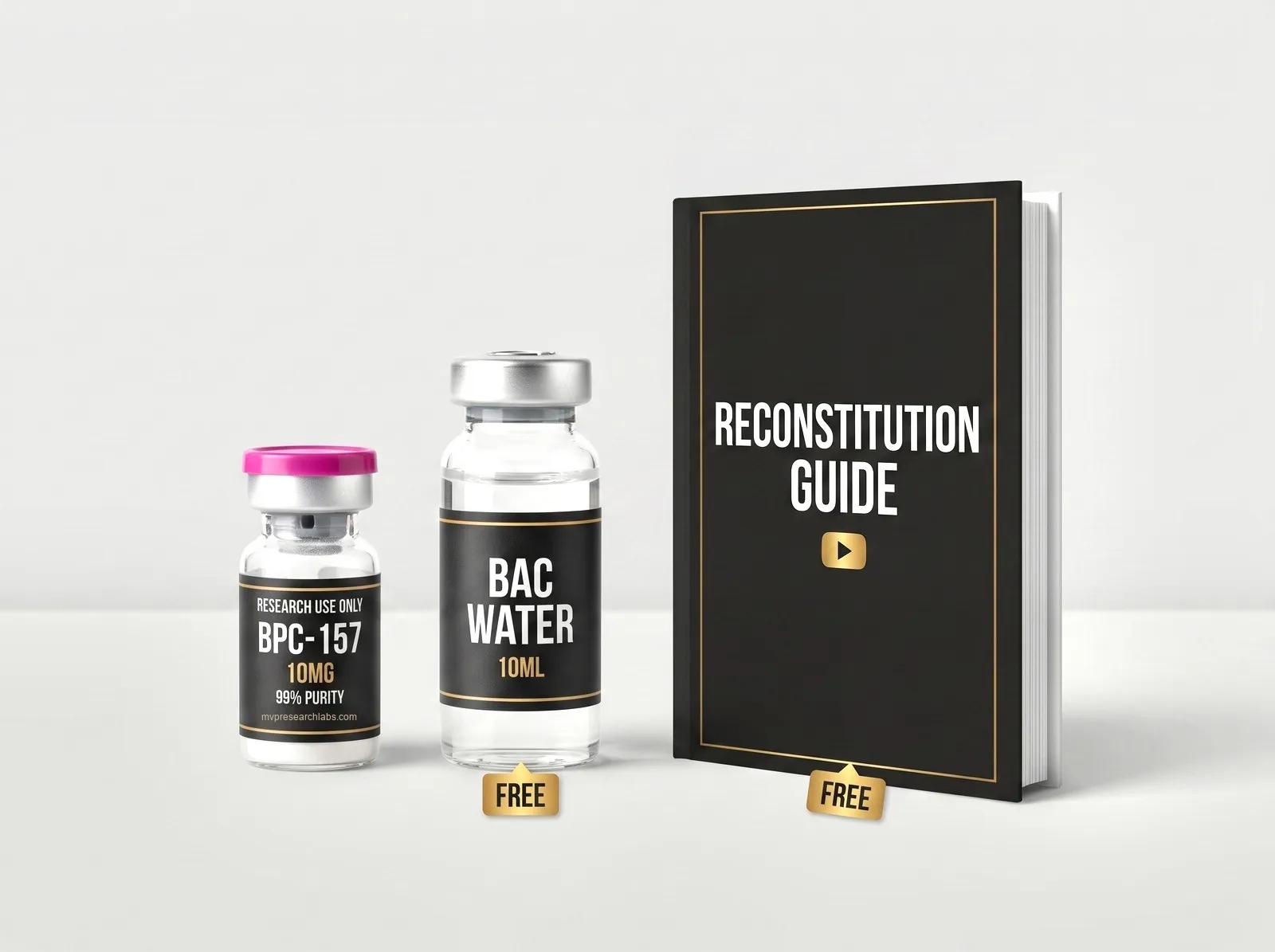
A vial containing 10 mg of lyophilized peptide is reconstituted with 2 mL of bacteriostatic water. The concentration is 10 ÷ 2 = 5 mg/mL, which is 5 µg/µL. An aliquot of 250 µg therefore needs 250 ÷ 5 = 50 µL of solution, and the vial yields 10,000 ÷ 250 = 40 aliquots.
Accuracy notes for the lab
▪
The label states the gross fill. Net peptide content, the actual peptide after counter-ions and residual water, is usually lower. Use the net peptide value from the Certificate of Analysis when exact molar amounts matter.
▪
Pipette the diluent with a calibrated pipette rather than estimating from vial graduations, and let the cake dissolve fully before drawing an aliquot.
▪
Choose a volume that gives an easy-to-measure concentration. Very small aliquot volumes amplify pipetting error.
For laboratory research use only. This calculator performs unit conversions for in-vitro work. It is not a dosing tool and must not be used to prepare anything for administration to humans or animals.
Members can split any order from {{ tabMinStr }} in {{ tabSplits }}: half today, the rest over three weeks on the same card. We float up to {{ tabCapStr }}, and bigger orders simply start with a bigger first payment. No interest, no fees, nothing hidden. The order ships right away.
Load {{ bsMin }}+ vials onto one ticket and send a single link. Everyone who orders through it pays {{ bsOff }} less with free 2-day shipping, and {{ bsPoints }} of every order comes back to you in points.
Every product page is structured for quick comparison: available options, batch documentation, compound information, storage notes, and source references where available.
Quality you can verify, not just trust
Product pages are built around evidence: variation data, CoA links, purity/lots/tested dates where available, and organized research references.
99%+Purity focus
5Quality checks
100%Catalog review
Verified Potency
HPLC-style CoA details are linked on product pages where the source provides them.
Purity
Purity values, lots, and tested dates are surfaced inside product detail tables.
Stability
Storage guidance and reconstitution notes are organized in the long description.
Consistency
Variation pricing and vial sizes are mapped consistently across the catalog.
Why choose MVP Research?
Built for a clean research-shopping experience: fast scanning, documented products, and a simple path from product card to checkout.
Always in Stock
Top research peptides are presented clearly with available vial sizes and quick product access.
Volume Pricing
Variation pricing keeps larger research options easy to compare from each product page.
Safe & Protected Shipping
Discreet, insulated packaging with free shipment protection on every order.
Researcher Community
Membership and partner messaging sit naturally inside the community section.
CoA Access
Certificate links stay close to the product data instead of being buried in generic copy.
Clean Catalog
Images, tags, categories and variations have been cleaned for a more focused store.
What researchers report
{{ avgStars }}{{ avgStr }} out of 5 · {{ reviewCount }} verified reviews
Each batch is analyzed by an independent, accredited third-party laboratory before it ships. This is the released report for the current batch, exactly as the lab signed it.
⚠ Placeholder release data. Laboratory name, lot numbers, purity and assay results are stand-ins until the client supplies the real certificates. Nothing on this card has been issued by a laboratory.
Every research claim on this page traces back to one of the {{ prLitCount }} publications below.
{{ l.n }}{{ l.src }}{{ l.title }}
Important research notice
Not for human, veterinary, or food use. This product is sold exclusively for research and educational purposes. It is not intended to diagnose, treat, cure, or prevent any disease.
All research findings presented on this page are sourced from peer-reviewed journals and official publications. They are provided for educational reference only and should not be interpreted as medical advice or product claims.
By purchasing this product, you confirm that you are a qualified researcher and will use it in accordance with all applicable laws and regulations. See our Disclaimer and Terms of Service.
By placing this order you confirm that you are a qualified researcher and that all products are purchased strictly for research and laboratory use, not for human or veterinary use.
Pick any {{ boxSize }} research compounds and we pack them into one monthly box with free 2-day delivery. {{ boxMonths }} deliveries to start, and you can swap anything once your first box ships.
{{ st.big }}
{{ st.t }}
{{ st.s }}
{{ p.purity }}CoA
{{ p.name }}
{{ p.category }}
{{ p.boxPriceStr }}{{ p.retailStr }}in box
No compounds in this category.
{{ boxCount }} of {{ boxSize }} picked{{ boxMonthlyNowStr }} per month
Bulk orders
Order in bulk
Ten or more units of any single compound unlocks 40% off. Reach fifty and the whole product drops to 50%. Same CoA-verified vials, one-time order, no subscription.
{{ t.off }}
{{ t.title }}
{{ t.sub }}
Configure your order
{{ bulkQtyNow }}
Research bundles · New
Build a bundle
Load {{ bnMin }} or more vials onto one ticket and share a single link. Everyone who orders through it pays {{ bnOff }} less with free 2-day shipping, and {{ bnPoints }} of every order comes back to you in points.
Every order earns points, and {{ memRate }} points are worth $1 off a future order. It stacks automatically: the more you order, the more comes off what you order next.
{{ pl.badge }}
{{ pl.name }}
{{ pl.blurb }}
{{ pl.priceStr }}
{{ pl.subStr }}
2 MONTHS FREE
◆{{ pl.mult }} points per $1
✓{{ memPerk1 }}
·{{ memPerk1 }}
✓{{ memPerk2 }}
·{{ memPerk2 }}
✓{{ memPerk3 }}
·{{ memPerk3 }}
✓{{ memPerk4 }}
·{{ memPerk4 }}
★{{ pl.x1 }}
★{{ pl.x2 }}
How it works
{{ hw.tag }}
{{ hw.t }}
{{ hw.s }}
Referral partner program
Help researchers find quality supply.
Refer colleagues, labs or research teams to MVP Research. Share a source you trust, and share in the value it creates.
{{ ps.big }}
{{ ps.t }}
Apply as a referral partner
No waiting period and no minimum volume. You get a referral code immediately, and payouts start at a {{ pMinPayout }} balance.
How it works
{{ st.n }}
{{ st.t }}
{{ st.s }}
Why refer researchers to us
{{ w.t }}
{{ w.s }}
{{ pFirstStr }}
First order commission
Value on every researcher's first order. The researcher you refer also gets {{ pFirstStr }} off that order, so the introduction is worth making on both sides.
{{ pRecurStr }}
Lifetime recurring
On every reorder from researchers you refer, for the lifetime of their account. No time limit and no cap, with a {{ pMinPayout }} minimum payout.
{{ policyTitle }}
Last updated: {{ policyUpdated }}
⚠ Draft for client review. Entity name, governing law and venue are filled in from the information available and must be confirmed against the actual company registration, and the text reviewed by licensed counsel, before go-live.
All products in this category are sold strictly for laboratory research use. They are not intended for human or veterinary use, and nothing on this page describes administration to people or animals.
Full catalog
Research Peptides A–Z
All {{ catCount }} compounds, blends, pens and lab supplies MVP Research carries, in alphabetical order, with the research area, the available sizes and the starting price. Every product is sold for laboratory research use only and ships across the United States.
Practical guides on reconstitution, storage, purity testing and documentation, written for researchers in the United States. Every article describes laboratory work only. Our products are sold strictly for research use.
For laboratory research use only. This article describes in-vitro laboratory procedures and is not medical advice. MVP Research products are not intended for human or veterinary use, and nothing here describes administration to people or animals. See our Research Use Only policy.
Work out the concentration of a reconstituted lyophilized peptide and the volume of solution that contains a given amount. Concentration in mg/mL is numerically the same as µg/µL, which makes small aliquots easy to plan.
Concentration
{{ calcConcStr }}
{{ calcConcAlt }}
Volume for the target amount
{{ calcVolStr }}
{{ calcVolAlt }}
Aliquots per vial
{{ calcAliquotStr }}
{{ calcErr }}
How the calculation works
Concentration is the mass of peptide divided by the volume of diluent: C (mg/mL) = mass (mg) ÷ volume (mL). Because 1 mg/mL equals 1 µg/µL, the volume that contains a target amount is simply the target in micrograms divided by the concentration: V (µL) = target (µg) ÷ C (mg/mL). The number of whole aliquots is the total mass in micrograms divided by the target, rounded down.
Worked example
A vial containing 10 mg of lyophilized peptide is reconstituted with 2 mL of bacteriostatic water. The concentration is 10 ÷ 2 = 5 mg/mL, which is 5 µg/µL. An aliquot of 250 µg therefore needs 250 ÷ 5 = 50 µL of solution, and the vial yields 10,000 ÷ 250 = 40 aliquots.
Accuracy notes for the lab
▪
The label states the gross fill. Net peptide content, the actual peptide after counter-ions and residual water, is usually lower. Use the net peptide value from the Certificate of Analysis when exact molar amounts matter.
▪
Pipette the diluent with a calibrated pipette rather than estimating from vial graduations, and let the cake dissolve fully before drawing an aliquot.
▪
Choose a volume that gives an easy-to-measure concentration. Very small aliquot volumes amplify pipetting error.
For laboratory research use only. This calculator performs unit conversions for in-vitro work. It is not a dosing tool and must not be used to prepare anything for administration to humans or animals.
Certificates of analysis
The lab report behind every vial.
{{ coaTotal }} certificates across {{ coaCompounds }} compounds, eight assays per batch, run by an independent accredited laboratory. Read them before you buy.
⚠ Placeholder release data. Laboratory name, lot numbers and assay results are stand-ins until the client supplies the real certificates. Nothing on this page has been issued by a laboratory.
Holding a vial? The lot number is printed on its label.
MVP Research supplies research peptides exclusively to qualified researchers and laboratories for in-vitro and laboratory use. Please confirm both statements below.
By continuing you affirm the statements above are true. Products are not for human or veterinary use, are not for use in diagnostic procedures, and have not been evaluated by the U.S. Food and Drug Administration. See the Disclaimer, Research Use Only policy and Terms of Service.