Peptide Purity Explained: What HPLC Percentages Really Mean
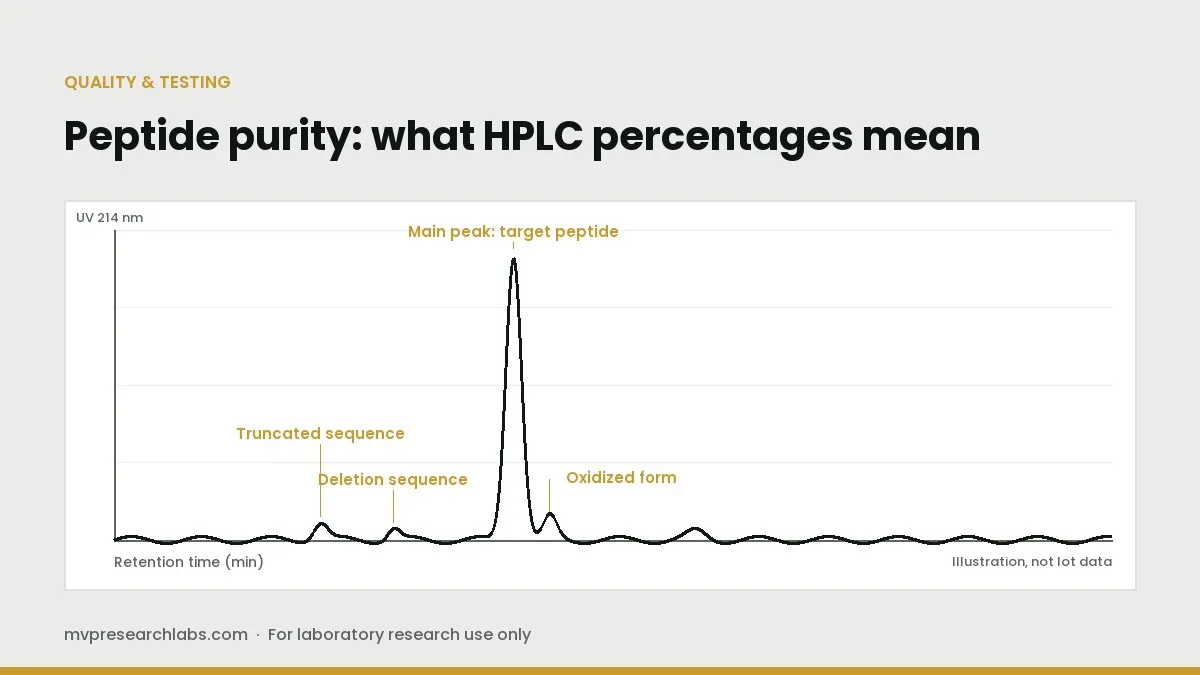
Purity is the number researchers look at first, and often the only one. But a percentage on a label only means something if you know how it was measured and what it leaves out. Here is what an HPLC purity figure actually tells you about a synthetic peptide, and what it does not.
How HPLC purity is measured
Synthetic peptides are almost always analyzed by reversed-phase high-performance liquid chromatography. The sample is injected onto a column packed with hydrophobic material, and a gradient of increasing organic solvent, usually acetonitrile in water with a little trifluoroacetic acid, elutes the components one by one according to their hydrophobicity. A UV detector at about 214 to 220 nm records each component as a peak. Purity is reported as the area of the main peak divided by the total area of all peaks.
What the impurities are
Solid-phase peptide synthesis builds a chain one amino acid at a time, and no coupling step is perfectly efficient. The minor peaks on a chromatogram typically include:
Deletion sequences, in which one amino acid is missing because a coupling step failed.
Truncated sequences that stopped growing partway through synthesis.
Incompletely deprotected peptides that still carry a protecting group.
Oxidized forms, commonly of methionine, and deamidated forms of asparagine or glutamine.
Diastereomers created when an amino acid partly racemizes during synthesis.
Many of these are very similar to the target peptide, which is why careful method development matters. A related impurity that co-elutes with the main peak inflates the purity figure without anyone noticing.
What the purity figure leaves out
HPLC purity describes UV-absorbing components only. It does not account for water, salts or counter-ions such as trifluoroacetate or acetate, which are present in every lyophilized peptide. That is why purity and net peptide content are reported separately. A peptide can be 99% pure by HPLC and still consist of only 70 to 85% peptide by weight.
Which purity grade do you need?
Peptide suppliers and core facilities commonly recommend purity levels by application. As a rough guide:
Around 70 to 85%: initial screening and non-quantitative work, such as some antibody production.
Above 95%: most in-vitro assays, including enzyme and receptor studies, and quantitative work.
Above 98%: sensitive quantitative assays, structural studies and experiments in which minor impurities could plausibly have biological activity.
Higher purity is not automatically better for every experiment, but it removes one source of doubt when you interpret results.
Questions to ask about a purity claim
Is the chromatogram available, and does it belong to the lot you received?
At what wavelength was purity measured, and with what gradient?
Was identity confirmed by mass spectrometry on the same lot?
Is net peptide content reported, or only purity?
How to read a peptide Certificate of Analysis →