How to Read a Peptide Certificate of Analysis (COA)
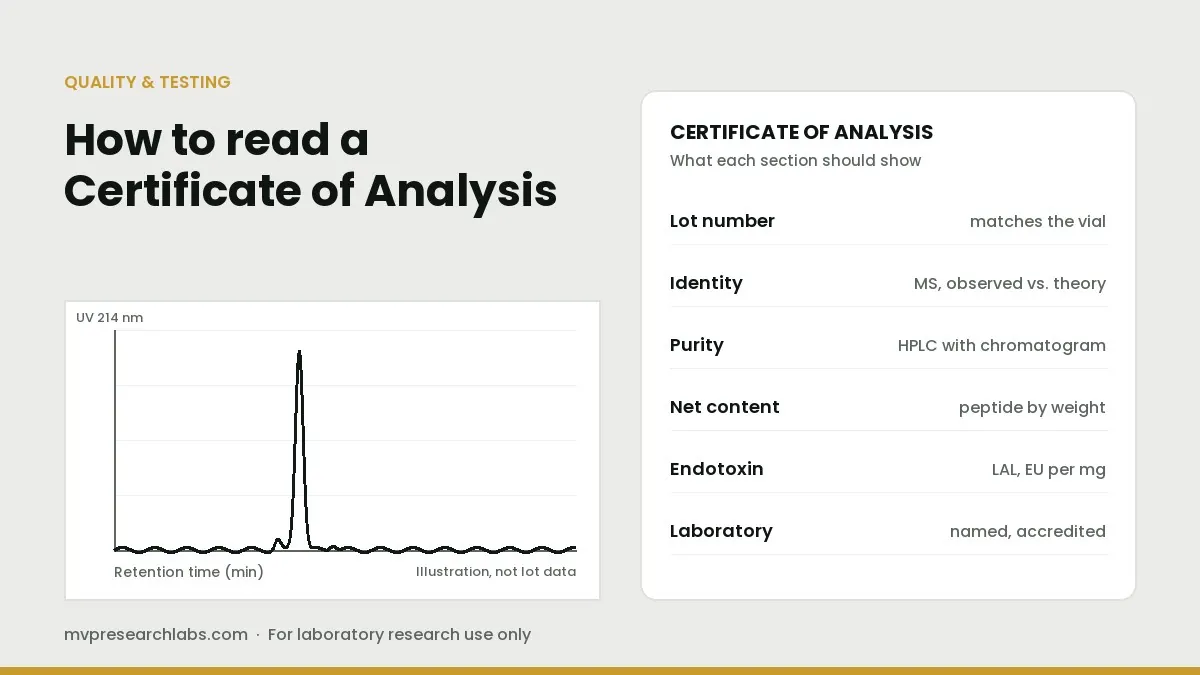
A Certificate of Analysis, or COA, is the document that connects a vial to the laboratory data behind it. For researchers it is the main evidence that a peptide is what the label says and pure enough for the intended experiment. Not every COA carries the same weight, though. This guide explains each section of a typical peptide COA and how to tell a meaningful certificate from a decorative one.
Header and traceability
The top of the certificate should identify exactly which material was tested:
Product name and sequence or catalog identifier.
A lot or batch number that matches the number printed on your vial.
Dates of manufacture and testing.
The name of the laboratory that performed the analysis and, ideally, its accreditation, such as ISO/IEC 17025 for testing laboratories.
A signature or approval by a responsible analyst or quality manager.
The lot number is the most important link. A COA that does not reference the lot you actually hold says nothing about your vial.
Identity: mass spectrometry
Identity testing confirms that the molecule in the vial is the intended peptide. It is usually done by mass spectrometry, most often electrospray ionization (ESI-MS) or MALDI-TOF. The certificate should list the theoretical molecular weight calculated from the sequence and the observed mass, which should agree within the tolerance of the instrument. A spectrum image makes the result verifiable.
Purity: HPLC
Purity is measured by reversed-phase high-performance liquid chromatography (RP-HPLC) with UV detection at around 214 to 220 nm, where the peptide bond absorbs. The purity figure is the area of the main peak as a percentage of the total peak area. A trustworthy certificate includes the chromatogram itself, not just a number, together with basic method details such as the column and the gradient.
Peptide purity explained: what HPLC percentages mean →
Net peptide content
Purity and content are different measurements. HPLC purity tells you what fraction of the UV-absorbing material is the target peptide. Net peptide content tells you what fraction of the total powder mass is peptide at all, as opposed to counter-ions such as trifluoroacetate or acetate and residual water. It is determined by amino acid analysis or nitrogen analysis and commonly falls somewhere between 60 and 90 percent. A 99% pure peptide can still contain only 75% peptide by weight.
Other tests you may see
Appearance, typically a white to off-white lyophilized powder.
Water content by Karl Fischer titration.
Counter-ion content, such as residual TFA.
Bacterial endotoxin by the LAL test, reported in endotoxin units per milligram or per milliliter. This matters for cell-based research.
Residual solvents and heavy metals for some applications.
Red flags on a certificate
No lot number, or a lot number that does not match the vial.
No named laboratory, or no way to contact it.
A purity figure without a chromatogram, or a mass without a spectrum.
Identical test dates, or suspiciously regular purity values, across many different lots and products.
Results that are too perfect to be plausible.
A test date that comes before the stated manufacture date.
What to do with the COA
File the certificate with your lab records next to the lot number, the date of receipt and the storage conditions. When results look unexpected, it is the first document to check, and it gives you a baseline if you later re-test the material yourself.